Health Is Not Merely the Absence of Disease
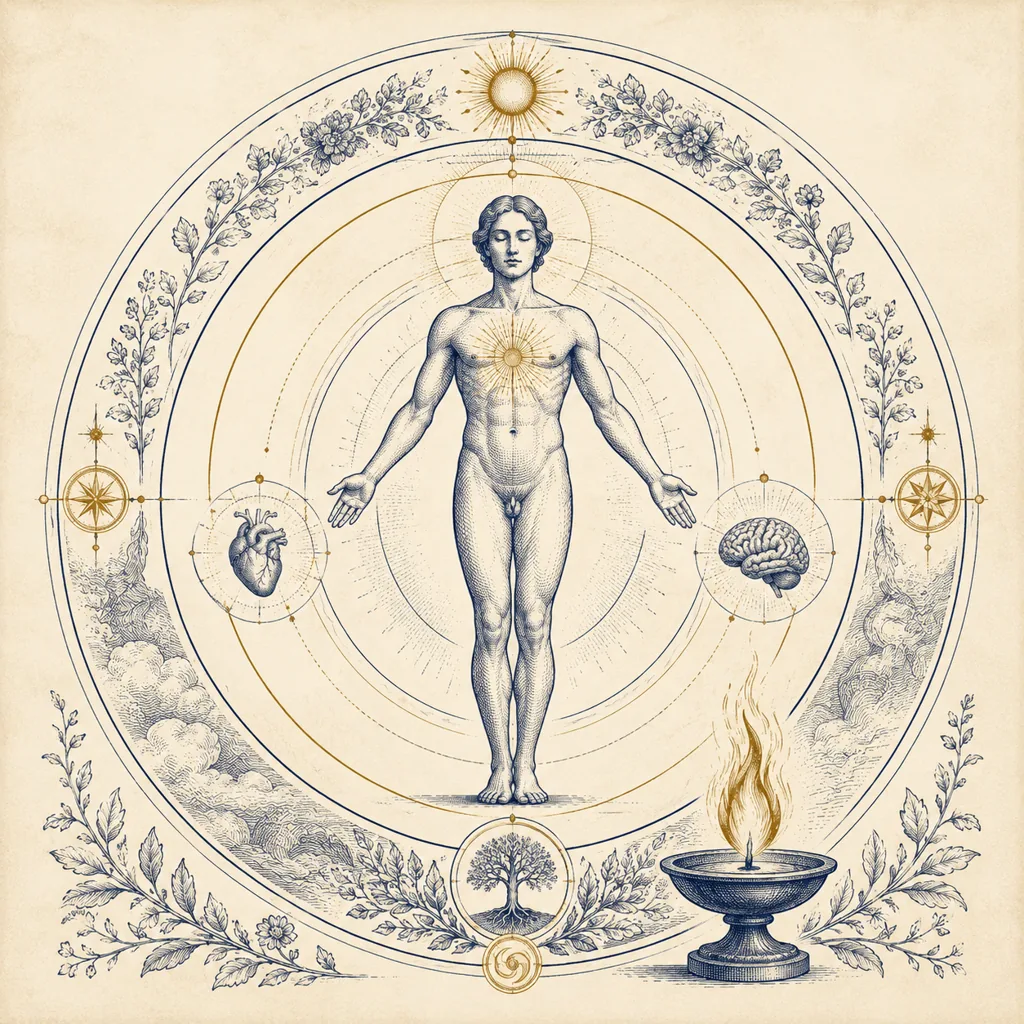
The person in balance — health as equilibrium of body, feeling, and vital force.
- By the end of this lesson you will be able to explain why, in homeopathic thinking, health is understood as a dynamic capacity rather than the mere absence of symptoms, and why symptoms are often read as signs of a living, responding organism.
Ask most people what health is and the answer arrives quickly: health is when you are not sick. It is a sensible everyday reply, and for ordinary conversation it works well enough. Yet the moment you sit with a patient and try to decide what you are actually trying to restore, that tidy definition begins to come apart in your hands. This is where David Owen opens his account of homeopathy, and he opens there deliberately. Before you can help someone move toward health, you have to be honest about what health is.
Consider the man who feels entirely well and comes in only for a signature, and whose examination quietly uncovers serious disease of the heart. By the "absence of symptoms" measure he was healthy right up to the moment of discovery. But nothing changed in his body when the finding was made; only his knowledge changed. In homeopathic thinking this exposes the gap in the old definition. Not perceiving a disturbance is not the same as not carrying one. Health, then, cannot simply mean the quiet you happen to feel.
A spectrum from suppressed silence through dynamic balance, with symptoms shown as signals rather than the disease itself.
If the absence of symptoms is not health, what is? In the homeopathic frame, health is described as a dynamic state of balance: the living capacity of an organism to meet challenges, adapt, recover, and continue to grow. It is not a fixed, silent plateau but an ongoing act of self-regulation. Hahnemann named the animating principle behind this self-regulation the vital force, and practitioners hold that its job is precisely to keep the whole organism ordered and responsive.
This reframing changes how symptoms are read. If health is adaptive capacity, then many symptoms are not the disease at all; they are the organism responding. Tiredness asks for rest, pain protects an injured part, a fever signals an immune system doing its work. Owen offers small provocations to press the point: a person who feels notably better after passing through a cold, another whose energy leaps only after a well-chosen remedy, suggesting they were less well before than anyone realised. From this angle, a person who can mount a clean, vigorous acute illness may be showing vitality, not weakness. To silence such a response too quickly, practitioners caution, may rob the vital force of the very reaction through which it was completing its work. Health is thus a matter of degree and direction, and symptoms are read as part of its language rather than simply its enemy.
A patient tells you he feels perfectly well and only wants a certificate signed. A routine check reveals significant, silent heart disease. How would a homeopathic framing describe his state before the check?
Think of a time you felt 'fine' yet later learned something had been building beneath the surface. What would a fuller picture of your health have included beyond how you happened to feel that day?